
Where your roof water actually ends up
Inspection blog, 2026-04-14
People skip gutters here because it rains so little. The reasoning runs backwards. San Diego averages around ten inches a year and most of it lands in a handful of winter storms, so the roof sheds a season's worth of water in a few hours onto ground that has been baking since May.
Where the water ends up
Without gutters, water comes off the eave in a sheet and lands in a trench beside the foundation. On the expansive clay soils inland, in Santee, El Cajon, Lakeside and parts of Spring Valley, that soaking swells the clay under the slab edge while the soil on the other side of the house stays dry. The differential is what moves foundations.
Splashback is the other half. Water hitting dirt bounces two feet up the wall and drives grit and moisture into stucco, siding and the bottom plate of the framing.
What a downspout should do
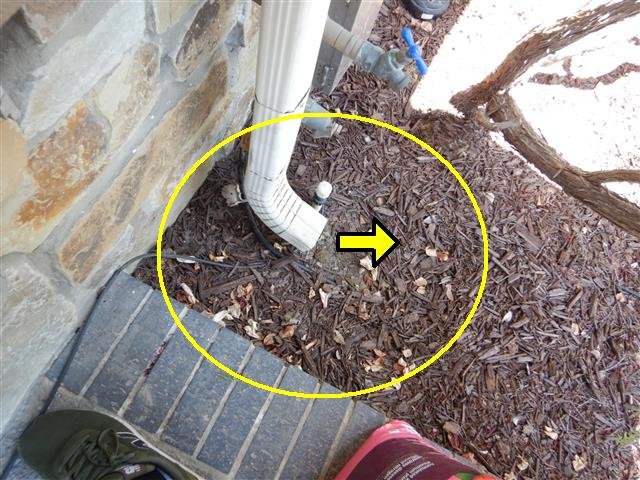
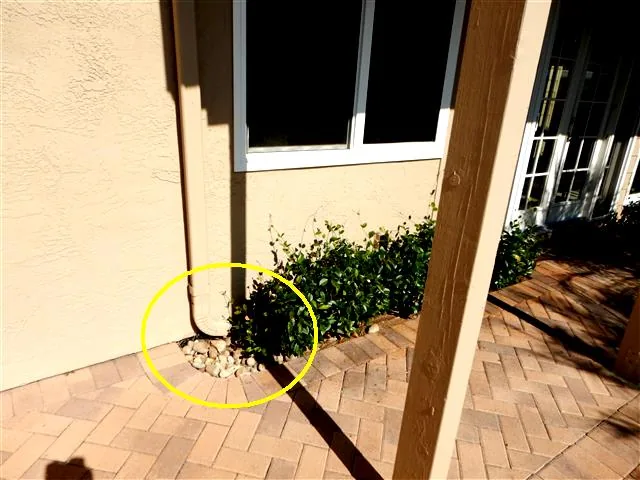
Getting water into the gutter is the easy part. Getting it away from the house is where most systems fail. A downspout that ends at a splash block six inches from the wall has moved the problem by six inches.
You want discharge at least four to six feet out, further on clay, either through a buried solid pipe to daylight or a sloped extension on the surface. Perforated pipe is for draining soil, not for carrying roof water, and we find it used for both.
Grade should fall about six inches over the first ten feet away from the foundation. Decades of mulch and new planting beds tend to reverse that slope quietly.
What we check
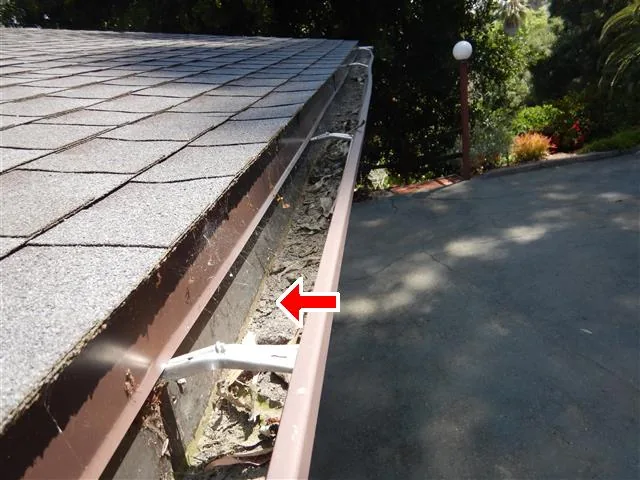
Standing water in a level gutter run, which shows as a tide line of silt and a patch of rust. Separated or leaking seams at corners. Fasteners pulled loose from the fascia, usually because the gutter has been carrying the weight of wet debris all winter. Downspouts that drain onto a walkway or a driveway that slopes back toward the house. Buried drain lines that go underground and stop at a crushed elbow, which we can only confirm by running a hose.
Under jacaranda, eucalyptus and pepper trees, expect the gutters to need clearing twice a year. Palm debris is worse, since the fronds hold shape and dam the outlet.
A quick test
Put a hose on the roof during dry weather and watch. You are looking for water that overshoots the gutter at a valley, spills over a low spot in the middle of a run, or backs up at a downspout outlet. Twenty minutes in October is cheaper than finding out in February.
More from the field


Your home is a major investment.
Protect it with San Diego's certified, 5-star-rated inspectors.